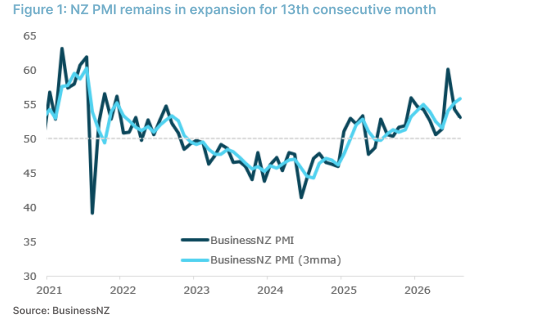
The kiwi softened last week as global risk sentiment soured, driven by the broad based rise in global bond yields and a further deterioration in the Middle East situation.Domestically the data was limited to just BusinessNZ's PMI for August. The data showed manufacturing activity continued to expand for over a year running, though the pace eased back from July. August PMI eased to 53.1 (from 54.3), yet continued to run a touch above the long term average of 52.5. Looking at the details, employment was the weakest sub index at 50 (easing from 52.2). New orders and finished stocks were the only two sub indices to improve through the month, suggesting some improvements in underlying demand. That said, production and deliveries both softened a touch but remained well in expansion. Sentiment weakened again, with 55.7% of comments negative, largely reflecting cost of living pressures and the ongoing Middle East conflict, though some respondents flagged steady or improving order books.Looking ahead, the key focus this week will be Q2 GDP data. The RBNZ expects growth to be flat through the quarter, with the annual rate rising to 2.1% from 1.5%. This flat outcome would likely reflect higher fuel prices weighing on the private sector, particularly households, though resilience elsewhere in the economy will likely prevent overall economic growth going backwards. RBNZ has indicated it can afford to wait on the next OCR hike until later in the year, though it continues to stress that the path ahead isn't fixed given how uncertain the outlook remains. In our view, given GDP is relatively backwards looking and higher frequency data has been rather mixed since then, the outcome of the data coming in a touch stronger than forecast would likely offer only marginal reassurance on the recovery, not enough to meaningfully alter the bank’s thinking. Indeed, we continue to expect one more RBNZ hike in Feb-2027, taking the OCR to 3%. That said, growing inflation risks in recent weeks, driven by the Middle East escalation and rising oil prices, have put this view under challenge, and we could revisit it and bring the call forward to Dec-2026.
Global markets were dominated last week by a broad based sell off in government bonds, with yields pushing to multi year highs even as US Treasury Secretary Bessent continued his bond buyback program. Markets grew cautious ahead of Friday's US CPI print, the last major reading before the Fed's meeting, while a stronger than expected August payrolls report boosted bets on a hike rather than a cut. Fed Chair Kevin Warsh has also turned more hawkish, warning there is still work to do on inflation. Structural pressures are adding to the move too, with large US fiscal deficits and a debt pile above 40 trillion dollars pushing up the term premium on long dated debt. The sell off is global rather than a US story, with yields rising in tandem across other major economies, and the Treasury's own buyback efforts have done little to slow the trend.The key data event of the week was the US CPI release. Headline US CPI rose 0.4% MoM in August, matching consensus, with the annual rate holding steady at 3.4%. However, core inflation increased 0.3% MoM, above the 0.2% forecast, while the core annual rate eased slightly to 2.4%. Energy prices jumped 2.1% MoM, led by a 3.9% surge in gasoline, which also pushed airline fares 2.7% higher. Housing prices (the largest individual component of CPI) remained somewhat benign. The data saw the US dollar firm, as expectations of a Fed rate hike next week rose, with markets now pricing roughly 90% odds of a 25 basis point move.The ECB delivered a widely expected 25bp hike this week, taking its policy rate to 2.50%, and said it remains “vigilant” given the current environment. President Lagarde noted there is no evidence yet of inflation pass through in the euro area, though the Bank expects inflation to stay elevated for an extended period and will continue to assess policy on a data dependent, meeting by meeting basis. The ECB also lifted its inflation projections for 2027 and 2028, to 2.5% and 2.1% respectively, on the back of an upward revision to core inflation. Sources close to the ECB suggested officials expect to raise rates further, with another hike possible as soon as next month.Elsewhere, the Japanese Yen extended its rally, hitting its strongest level in seven months, with USD/JPY briefly touching 153 and surpassing levels following last month intervention. The move in the yen reflects growing conviction that the BoJ will hike rates at next week's meeting, alongside a market view that Japanese authorities remain ready to intervene again if needed. Finally, tensions in the Middle East showed no sign of easing, with Brent crude prices reaching $104/bbl by the end of the week. A fresh round of strikes between the US and Iran has raised concern that flows through the Strait of Hormuz could remain constrained for some time, with both sides appearing to prepare for a protracted conflict rather than a near term ceasefire. That said, there was some reprieve late on in the week after there were reports that Middle Eastern foreign ministers were trying to negotiate a temporary deal with Iran to manage shipping through the Strait of Hormuz. This saw some modest gains for both antipodean currencies late on in the week offsetting only some of their earlier losses.