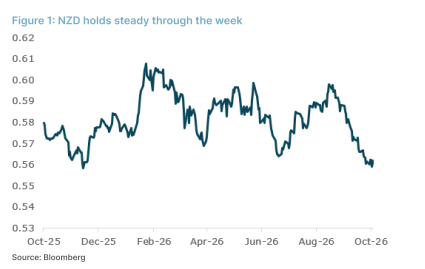
The kiwi ended the week unchanged. The domestic calendar was light, with offshore attention centred on the Fed commentary and ongoing tensions in the Middle East.Domestically, the data was limited to the Q3 QSBO Survey and ANZ card spending for September.The QSBO showed a sharp lift in business confidence, with the headline gauge rising to +40 from+14, a level last seen in December before the Middle East conflict hit sentiment. Hiring intentions improved and price pressures eased, though both remain elevated.
As flagged in our midweekupdate, the QSBO survey wasreturned in September, so it onlypartly captures the recent rise infuel prices, and headlineinflation is expected to pick upagain toward year end.ANZ card data pointed to a solidconsumer, with spending up0.5% MoM in September andannual growth lifting to 5.8%from 4.1%. Fuel did much of theheavy lifting, so the underlyingpicture is softer than theheadline suggests, withdiscretionary spending uneven.Looking ahead, the domesticfocus turns to the BusinessNZPMI for September. As we havestated for some time, NZeconomic indicators have beensending mixed signals, so theprint will help show whetheractivity is holding up.
Globally, it was a light week for data, leaving markets to focus on a hawkish read from the Fed, bond yield shovering near multi decade highs and continued tensions in the Middle East impacting the oil market.The FOMC minutes struck a mildly hawkish tone. Most participants saw another hike by year end as likely appropriate, and several judged policy to be only mildly restrictive at best, with economic momentum appearing to build. Many also viewed financial conditions as supportive of growth, pointing to strong equities and tight corporate spreads despite higher Treasury yields.Fed Governor Waller reinforced that message, signalling that further hikes will likely be needed, although there is flexibility on timing. He sees the balance of risks as little changed since the September meeting, with activity strengthening, the labour market broadly stable and inflation risks skewed to the upside. Waller stressed that he is not greatly concerned that tighter policy threatens a damaging slowdown, but he is wary of inflation reaccelerating. He stressed that policy is not on a predetermined path, noting that hikes do not need to come at consecutive meetings but should be in place within an acceptable period of time.Global bond yields were volatile this week but ended modestly lower after hitting multi decade highs. The US 10 year Treasury yield eased to 5.23% from a 24 year high of 5.35%. Yields remain structurally elevated, with markets pricing in rates staying higher for longer on the back of stubborn inflation, rising energy prices and heavy government debt issuance.
On oil markets, Brent crude prices ended the week higher as Iranian attacks raised the prospect of wider hostilities in the Middle East. The pace of attacks in the Strait of Hormuz picked up, with the UK Maritime Trade Operations reporting nine so far this month, including the first inside the Persian Gulf in about a month. Reports that the US was preparing to resume military action added to the tension, while there were reports that the Houth is struck two airports in Saudi Arabia.However, there was some reprieve provided at the backend of the week as President Trump stated that the US will not attack Iran before the 3 November midterm elections, describing talks with Tehran as productive. The pledge helped temper rising crude prices after reports that Washington was weighing new strikes, and the blockade remains in full force.President Trump also claimed 22 million barrels moved through the Strait of Hormuz in a single night, with none going to or from Iran, though that figure has not been independently verified. Before the war, roughly a fifth of the world’s oil and LNG passed through the strait, and it was all but closed after the US and Israel struck Iran in late February.