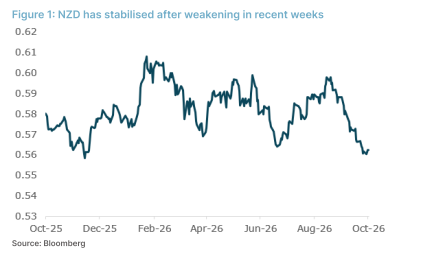
The kiwi has been broadly steady this week as risk sentiment has recovered modestly. On the data front, the focus was on the NZIERQSBO for Q3, alongside ANZ card spending for September.The QSBO showed NZ firms feeling noticeably better about where the economy is heading,even though current conditions remain uneven. The headline confidence gauge climbed from+14 to +40 on a seasonally adjusted basis, returning to levelsl
ast seen in December before the Middle East conflict hit sentiment. Much of that lift likely reflects how soft things have been, which leaves plenty of room for improvement. Activity was a little softer, with the balance of firms reporting recent trading moving from +1 to -1.
The labour market showed signs of firming. Experienced employment improved to -5,close to its typical level, and hiring plans for the next three months swung from -1 to +23. That said, it is becoming apparent that hiring is getting harder, with skilled staff tougher to find (-9 to -15) and unskilled workers much less plentiful (+17 to +1). This is consistent with some of the employment indicators data last week suggesting labour demand remains robust, as filled jobs rose again in August. On inflation, price pressures cooled from elevated levels. The balance of firms reporting higher selling prices dropped from +41 to +26 and cost increases eased from +54 to +47, though both sit above long term norms. Profite xpectations improved sharply,from -22 to +6.
Rate expectations climbed 5.5% to 179.7, just shy of May's cycle peak. Among those surveyed after the hike, just over 80% expect mortgage rates to rise further over the next year, up from 63% last month, and the share is closer to 90% among mortgage holders. On the labour market, the unemployment expectations index rose further through the month, pointing to a higher unemployment rate ahead.
Surprisingly, the sentiment around the housing market wasthe notable exception. The time to buy a dwelling indexrose 3.4% to 88.4, likely as a result of the recent easing in-house prices. Whilst house price expectations gained 4.3%to 115.1 after a sharp slide over the previous six months.
Globally, it has been a relatively quiet week on the datafront, with just a few key releases out of the US.
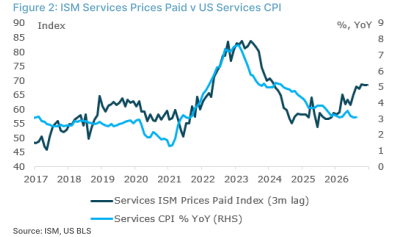
The September ISM services index slipped to 54.9, yet still remained expansion for a 27th straight month. Activity cooled, with the business activity gauge falling to 56.5 and new orders easing to 59.8. Firms are still facing rising input costs, with prices paid climbing 1.4 pts to 74.0. This points to elevated services inflation ahead. Employment moved back above 50 at 50.1, pointing to a labour market that looks broadly balanced.
The US trade deficit blew out to USD 105.6bn in August from USD 92.8bn in July, its largest since March 2025 when importers rushed in goods ahead of tariffs. Imports jumped 4.3% m/m, led by crude oil, gold and capital goods, outpacing a 1.4% rise in exports. Deficits with Mexico and Vietnam hit record levels, and the gap with Canada also widened sharply.
Beyond the data, the focus was the FOMC minutes released this morning, which struck a mildly hawkish tone.Most participants saw another hike by year end as likely appropriate, and several felt policy was only mildly restrictive at best, with economic momentum appearing to build. Many also judged financial conditions as supportive of growth, pointing to strong equities and tight corporate spreads despite higher Treasury yields.
That said, global markets have been interesting, inparticular the bond market. The selloff continued into thisweek, with the US 10 year yield jumping as high as 5.35%,its highest since April 2002, while the 30-year touched5.70%, its highest since May 2002. Both have since pulledback, but yields continue to remain elevated. In our view,Fed pricing is not the driver, with markets still seeing only one in five chance of a hike later this month. This points to a higher term premium on heavy borrowing, inflationrisks and AI driven growth expectations.
In Europe, French bonds were back in focus as the budget process kept markets on edge. Indeed, the French andGerman 10 year yield spread reached nearly 1.5%, itswidest since the 2012 euro crisis, and the euro has alsocome under pressure.
On oil markets, Brent crude edged higher over the past day as Middle East tensions picked up again. Iranian state media reported a blast heard from the sea off Qeshm Island, reviving concerns of another flare up in the conflict with the US. In saying this, prices have been choppy this week, with traders weighing rising supply out of the Persian Gulf against the risk to tankers moving through the Strait of Hormuz.