The kiwi ended the week near a two month low, weighed down by a hawkish Fed as expectations for another hike before year end boosted the US dollar. Losses were somewhat contained by stronger than expected domestic GDP data, which pointed to some underlying resilience despite the energy shock stemming from the ongoing Middle East conflict.
Domestically, the focus was on Q2 GDP data, which came in a touch stronger than expected. The economy expanded 0.2% QoQ, above both the 0.1% consensus and the RBNZ's flat forecast, while upward revisions to prior quarters lifted annual growth to 2.6% YoY, well above the 2.2%consensus. The details showed resilience across much of the economy,even as higher fuel prices weighed on sectors like hospitality and transport.
Elsewhere, SPI data for August showed inflation running a little softer than expected, driven largely by weaker holiday accommodation and airfare prices, alongside continued firmness in food and meat prices.This was partly offset by a further lift in fuel prices amid renewed Middle East tensions, which is expected to keep headline inflation elevated ahead. That said, the softer August print does pose some downside risk to the RBNZ's Q3 forecast of 0.8% QoQ / 3.9% YoY.
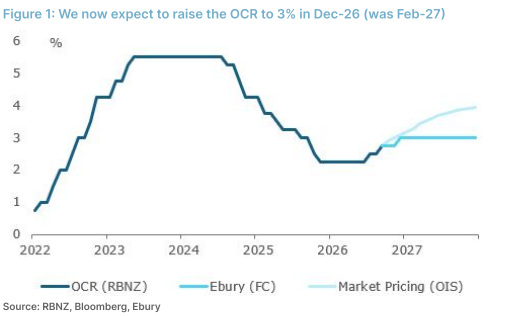
Overall, as flagged in our weekly last week, GDP is a lagging indicator,and while higher frequency data has continued to be mixed since Q2, ithas leaned more toward resilience than weakness. As such, we don'tsee the GDP print as enough on its own to meaningfully shift the RBNZ'sthinking, particularly with offshore volatility likely to keep the upcomingdata flow quite volatile ahead. That said, at the September meeting theRBNZ was already leaning toward a pause in October, and recent globaldevelopments have added pressure toward hiking sooner rather thanlater. With this resilience adding to that case, we now expect the RBNZto bring forward its next hike, taking the OCR to 3% in December 2026,rather than our prior call of February 2027.
The week was dominated by three key central bank meetings, from theFed, the BoE, and the BoJ, though the Fed's decision was by far the most consequential for markets.
The Fed raised rates by 25bp to 3.75-4.00%, a unanimous decision under Chair Warsh and in line with consensus. The statement was brief,describing activity as solid but inflation and uncertainty as still elevated,framing the hike as accelerating the path to target rather than a shift in strategy. The dot plot carried the real signal. The median still points to one more hike this year with no cuts through 2027, but the distribution beneath it was more hawkish, with eight of 18 participants seeing the funds rate at 4.25 to 4.50% by end 2027. Notably, this hawkish shift came despite inflation forecasts barely moving from June, with growth and employment projections actually ticking higher, suggesting the Committee sees little cost to further tightening.
Warsh offered little forward guidance, again declining to submit his own dot, though he reiterated that inflation remains too high. Given the hawkish tone and wider dot distribution, we now expect one more hike in December. Markets currently price around 40% odds of an October move, though we don't expect the Fed to act that early.
Attention then turned to the Bank of England, who voted 6-3 to hold rates at 3.75%, in line with expectations, though it flagged inflation risks skewed to the upside despite limited evidence of second round effects so far. Governor Bailey signalled tightening may be needed should the Middle East conflict persist, as growth and inflation forecasts were both revised higher, with inflation now seen topping 4% in early 2027. Policy now hinges largely on how the conflict evolves.
The Bank of Japan raised rates to 1.25%, matching market pricing and marking its highest level since 1995. The 7-2 vote was wider than a clean hawkish consensus would suggest, with two dissenters arguing inflation hasn't accelerated enough to justify tightening, even as core CPI slowed to 1.7% YoY in August. Notably, two other board members pushed back from the opposite direction, arguing underlying inflation already justifies a faster pace. The yen sold off post announcement, reflecting doubts over board unity. We expect further quarterly hikes, reaching a neutral rate near 1.75% by Q1 2027.
Turning to the Middle East, Brent crude ended the week largely unchanged, easing slightly late on as Saudi Arabia said it expects to restore around half its damaged pipeline capacity within days. Supply remains tight overall, with delays facing Saudi crude buyers in Europe driving up other regional crude grades. Elsewhere, fighting between Yemen's Houth is and opposing forces has escalated as the group consolidates control of Yemen's Red Sea coast, while tensions between Iran and the US are also rising, with Trump telling Axios he is nearing a decision on whether to escalate attacks on Iran ahead of next week's meeting with Persian Gulf leaders