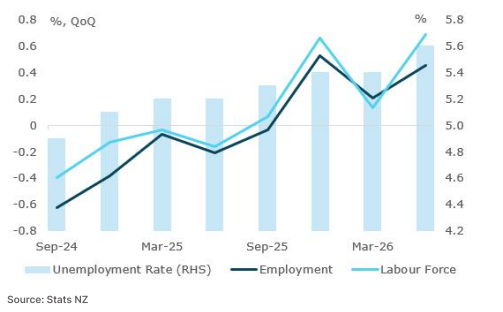
The kiwi ended the week modestly lower, weighed down by softer thanexpected labour market data before staging a partial recovery onimproving Middle East headlines around the Strait of Hormuz talks, onlyto lose steam again as those talks appeared to stall. NZD found somelate support from Friday's weak US payrolls print, though this wasn'tenough to fully offset the softer tone through the weekDomestically, the focus was Q2 labour force data, which came in weakerthan expected. The unemployment rate rose to 5.6% from a revised 5.4%in Q1, above both market and RBNZ expectations of 5.4%. Employmentgrowth held up better, rising 0.45% against expectations of 0.1%,suggesting the rise in unemployment owed more to stronger laboursupply growth of 0.7% QoQ and a tick up in the participation rate, asopposed to a deterioration in labour demand. NZD sold off sharply on the headline unemployment jump. Having saidthis, it is worth noting that the RBNZ operates under a single mandateand does not target full employment, though the data still offers a usefulread on how the labour market is holding up, and supports our view thatthe Bank needs to proceed with some caution. We continue to agree that further hikes are appropriate, but believe thepace should be a touch slower than markets currently expect, with justone more hike in September followed by a further move in February 2027that would take the OCR to 3%. Markets are still fully pricing two morehikes by the end of this year (52bps of rate hikes by year end), butpricing has tempered modestly following this data.
The yen was the main talking point globally this week, after US andJapanese authorities confirmed joint intervention to support thecurrency, the first such campaign since 1998. As flagged in our mid-weekupdate, Japan reportedly did the bulk of the work, with interventiontotalling close to $80bn and dwarfing the scale of its earlier attempts thisyear, while the Fed appeared to support via euro sales rather than directdollar selling. The scale of US involvement remains unclear, though thesignalling effect likely matters more than the actual flows. The movereflects growing concern in Washington that yen weakness has beenpushing Japanese bond yields higher, with worries this could eventuallyspill over into Treasuries given Japan's status as one of the largestforeign holders of US debt.USD/JPY settled towards 157.8, up from the lows of 155.5 earlier in theweek, yet well below the 163 levels at the end of July prior to theintervention. Overall, we still hold the view that intervention tends to buytime rather than reverse a trend outright. Indeed, further strengthening inthe yen will likely hinge on US data softening enough to keep the Fedsidelined, alongside a BOJ hike in September that markets are now fullypricing.On the Middle East, Brent crude oil pared its weekly losses as optimismaround a reopening of the Strait of Hormuz ran into fresh complications.Brent fell to a low near $78/bbl midweek after Iran said it had reachedagreement with Oman on a proposed shipping route through thewaterway, only to recover to around $84/bbl by week's end as the termsof that proposal drew scrutiny. Iranian media indicated Tehran wouldseek to bar US and Israeli vessels from the strait and demandcompensation from other states deemed hostile before grantingpassage, a stance that would leave most Gulf producers restricted inpractice.The proposal was also reported to require the US to lift itsblockade of Iranian ports, a condition Washington has so far resistedgiven its insistence that no single country control transit rights. Reneweddisruption added to the caution, with Iran's Fars news agency reportingstrikes on hostile targets within the strait and Houthi forces claiming alarge scale attack on Saudi backed troops in Yemen, layered on top ofongoing threats to Red Sea shipping. Markets nonetheless took somecomfort from signs that oil flows are gradually recovering.The week closed out with July's US payrolls report, which showed a netloss of 23k jobs against a consensus for a gain of 85k, while the prior twomonths were revised down by a combined 103k. Wage growth alsoslowed sharply, with average hourly earnings up just 0.1% on the monthagainst 0.3% expected, and 3.2% year on year from 3.5% previously,easing concerns around wage price inflation. The unemployment rateunexpectedly fell to 4.1% from 4.2%, though this was largely a function ofworkers exiting the labour force as participation continued to decline. Forthe Fed, the data reinforces the case to stay on hold at the Septembermeeting and supports our view for a prolonged pause, though futures arestill pricing around a 30% chance of a hike, with investors likely wantingto see confirmation of cooling inflation in next week's CPI print beforecommitting firmly to a status quo view