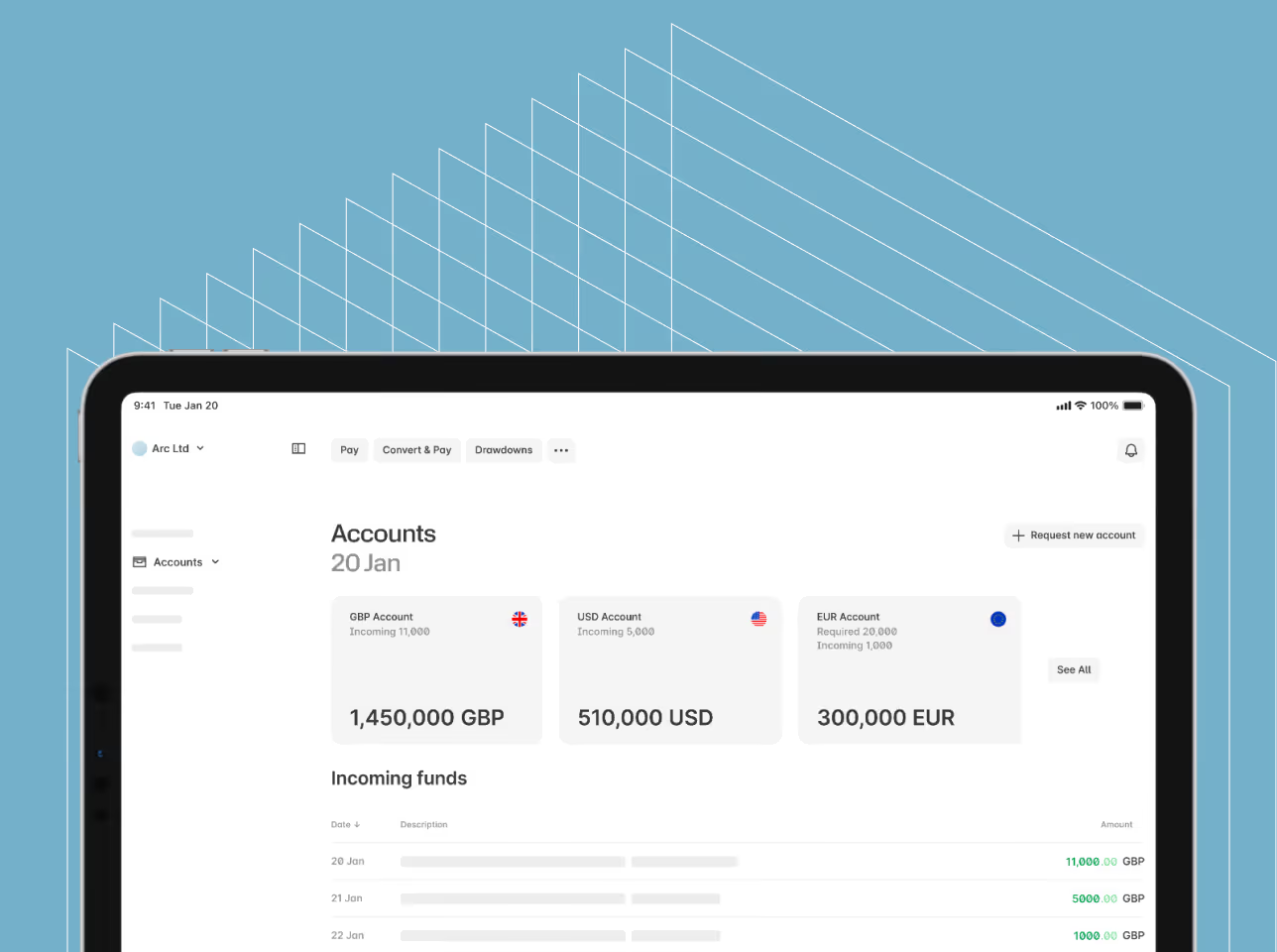
Almost all internationally operating institutions that span multiple jurisdictions face the same problem: as structures grow, managing global accounts becomes harder to control. This affects fund managers, asset managers, large corporations, and the service providers supporting them.
Most banks lack the footprint to service clients in every jurisdiction where an institution is active. Those with a global footprint often set high commercial thresholds. Institutions that have a limited need for financing generate limited commercial upside to banks, and often don’t meet the required commercial thresholds to be serviced well. As a result, these institutions work with multiple banking providers, each adding its own layer of administration to day-to-day operations.
For CFOs, treasurers and service providers managing multi-jurisdictional structures, this creates friction points in compliance, access and working capital.
Why every additional banking relationship means another KYC cycle
Each banking provider and jurisdiction has its specific KYC, AML and governance requirements. For a structure with entities in multiple jurisdictions, that means maintaining several separate compliance relationships on an ongoing basis. This creates administrative overhead at two levels:
- Redundant compliance reviews: Every provider requires its own documentation on its own schedule. This forces teams to repeatedly source and submit the same documentation throughout the year in different formats.
- User management: Adding a new user means completing a separate onboarding workflow for every bank and account. Adjusting authorisations, such as changing who can initiate or approve payments, means repeating those workflows each time a role changes.
A single platform reduces the administrative overhead in three ways:
- Compliance reviews: With a group-level review, shared documentation is submitted once and covers the structure.
- Adding user: A new user is set up once and given access to every account they need.
- Adjusting authorisations: Changes to who can initiate or approve payments are made in one place and apply across the required accounts.
What consistent account access looks like across a structure
Fragmented banking can create operational risk concerning who can act and when. The solution consists of a platform that allows for custom governance and oversight settings for a global user base.
- Access bottlenecks: Many providers rely on hardware security tokens for each individual account, limiting day-to-day access to a few individuals.
A single login with two-factor authentication across entities removes the need for physical tokens per bank. Workflows can be tailored to each use case to reflect the governance structure.
- Governance overview: When finance teams have a live view of every account, internal governance isn't disrupted, and they don't need informal approval workarounds.This keeps cash positions visible in real time, providing a consolidated view rather than a fragmented one.
What efficient working capital looks like across jurisdictions
Beyond administrative friction, siloed accounts affect how efficiently capital moves through a structure:
- Liquidity deployment: Fragmented accounts complicate cash pooling, leaving working capital idle in local operating accounts.
A single platform for multiple accounts enables efficient cash sweeping, providing clear visibility of all cash positions across currencies and jurisdictions.
- Currency gaps: Local bank branches often do not offer flexible multi-currency accounts and settlement options, which can mean extra FX costs or maintaining two banking relationships for the same entity.
A single provider can cover each currency an entity needs, without requiring additional banking relationships.
- Settlement speed: International settlements with traditional providers are usually at minimum T+2, slowing intercompany payments and cash velocity across subsidiaries.
Instant transfers between accounts on the same platform mean funds can move through the structure on the same day rather than taking several days.
Case study: How a US fund manager consolidated accounts across multiple jurisdictions
A US fund manager was raising European capital for its Cayman-domiciled fund through several European feeders. LP-specific SPVs were set up. Each entity required its own account, accessible to local directors, corporate service providers, and the fund's US-based CFO.
The US banking providers’ footprint did not extend to Europe. Approaching local banks in each location meant multiple onboarding processes. Onboarding was expected to take months because of the complex structure and limited commercial upside for banks, which risked delaying the fundraise.
The manager consolidated the fund's accounts onto a single platform, enabling a group-level KYC review and a consolidated view for the CFO.

Banking relationship: Each entity has its own account, accessed by local directors, corporate service providers and the fund’s CFO.
Operating across jurisdictions doesn't need to mean multiple banking relationships. A single group-level review, consolidated access and one platform for moving funds between entities is achievable. Consider payment infrastructure from the outset, rather than something that accumulates jurisdiction by jurisdiction.
Let's start a conversation
Get in touch with our experts to discuss your fund's needs and how Ebury can help, or visit our Institutions page to learn more.
Disclosure
Risk warning & legal notice: For informational purposes only; not financial, legal, or tax advice. Certain products, including derivative products, involve risk and may result in losses. Products and services described may not be available in all jurisdictions or from all Ebury entities; availability depends on the entity’s regulatory permissions and applicable local laws. Learn more about Ebury’s legal entities: https://ebury.com/group-legal-entities