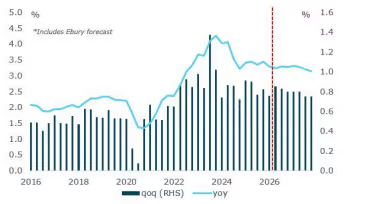
The Aussie retreated against the US dollar last week, as the greenbackcaught a renewed bid. Stalled US-Iran talks, the Trump-Xi meeting, theFederal Budget, and stronger-than-expected US inflation (both CPI andPPI) data were the key drivers behind last weeks movements.The Federal Budget delivered last Tuesday estimated an underlying cashdeficit of $28.3bn (1.0% of GDP) for 2025-26, with a $44.9bn cumulativeimprovement over the forward estimates relative to MYEFO. Net debt isexpected to peak near 22% of GDP by 2029-30, ($767.8bn), with grossdebt peaking at 35.8% of GDP in 2028-29, totalling around $1.2tn. Oninflation, Treasury forecast inflation peaking at 5% in June 2026 beforeeasing to 2.5% by mid-2027, with unemployment expected to risemodestly to 4.5% and hold there. There were key policy measuresannounced including further household tax relief, a shift in CGT to aninflation indexation model, the removal of negative gearing onestablished properties, NDIS reforms driving large fiscal savings, and afuel security package in response to the energy supply shock.Q1 WPI data was also released earlier last week, albeit it was slightlyovershadowed by the Budget. Wages rose 0.8% qoq, in line withexpectations, with annual growth holding at 3.3%. Private sector wageswere up 0.8% qoq, though annual growth eased to 3.2% (from 3.4%).Public sector wages were softer, rising 0.5% qoq with annual growtheasing sharply to 3.3% from 4.0%. Looking ahead, wages growth looksset to remain solid as inflation pressures broaden. This is already evidentin the ACTU's decision to revise its minimum wage claim higher — to 6%(from it’s earlier 5% submission) — in response to the sharp rise ininflation. Should such trends continue across the economy, this couldpresent risks for the RBA in keeping inflation expectations anchored.NAB Business Survey was also released earlier in the week, whichshowed confidence nudging up to -24 in April from -29 - yet remaining atweak levels. Conditions slipped further to 3 from 6, largely driven bysurging energy costs squeezing margins and curbing investment. On theinflation front, purchase costs rose 4.5% through the month, which wasfar stronger than selling price growth of 1.8%.
Figure 1: We expect wages growth to remain solid ahead
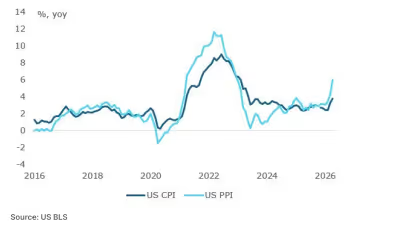
Offshore, the focus fell was on US inflation data for April, as US-Iranpeace talks seemed to stall. Headline CPI rose 0.6% mom, in line withexpectations, lifting the annual rate to 3.8% from 3.3%. Energy pricesjumped 3.8% — following a 10.9% surge in March — driven by the Iranconflict and the closure of the Strait of Hormuz. Shelter costs rose 0.6%(from 0.3%) and food prices climbed 0.5%. Core CPI came in slightlyahead of expectations at 0.4% mom, with the annual rate rising to 2.8%.More concerning, producer prices rose far stronger than expectedthrough April. US PPI surged 1.4% mom — well ahead of the 0.5% marketexpectation — pushing the annual rate to 6.0% from 4.3%, the largestincrease since December 2022. Goods prices jumped 2.0% mom, led by a15.6% surge in gasoline, while services prices rose 1.2% mom. Core PPIwas also strong, rising 1.0% mom against a 0.3% expectation, with annualgrowth lifting to 5.2% (from 4.0%). Import and export prices were also strong, rising 3.3% and 1.9% momrespectively in April. On the consumer side, retail sales were robust, up0.5% mom, with the control group - which feeds directly into GDPhousehold spending - also rising 0.5% mom. Taken together, broadeninginflation pressures and resilient consumer spending suggests that the USeconomy is running stronger than most had anticipated. Indeed, as aresult, Fed rate expectations have repriced, with markets pricing in hikesby mid-2027. Overall, the dollar strengthened sharply on the combinationof the data and the resulting hawkish repricing.Additionally, President Trump and President Xi met in Beijing last week,agreeing to a "strategic stability" framework for the next three years, astrade envoys reached broadly positive outcomes. On the sidelines, theUS and China agreed to lower tariffs on some unspecified products topromote bilateral trade, per China's Commerce Ministry, which alsoconfirmed China's plan to purchase US planes and address US concernson agricultural imports. Trump invited Xi to visit the US in September,though Xi issued a sharp warning over Taiwan.
Figure 2: US producer prices hints at further rises in consumer prices