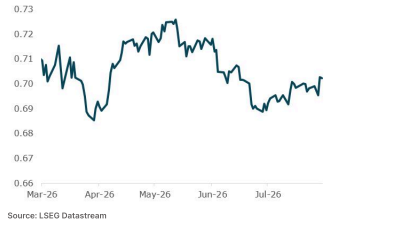
The Aussie closed higher this week, though the path there was volatile.AUD weakened sharply midweek after softer than expected localinflation data reduced the near term probability of further RBAtightening, before recovering into Thursday's FOMC meeting, where aweaker US dollar drove a broad based bounce. This weakness wasreinforced by modestly softer US data, and extended further into Fridayas the yen rallied sharply on reports of direct FX intervention fromJapanese authorities.Domestically, June CPI was the key focus, with headline inflation falling0.1% MoM in both original and seasonally adjusted terms, taking theannual rate down to 3.8% from 4% in May and below the 4% consensus.Trimmed mean inflation rose 0.3% MoM, holding the annual rate at 3.6%,below both the RBA's own May forecast of 3.8% and the 3.7% consensus.The data reinforced Bullock's dovish tone from her speech a day earlier,in which she flagged that parts of the economy were cooling faster thanthe Bank had expected, and AUD sold off sharply on the release asmarkets repriced lower the odds of further hikes.Transport was the largest drag on the headline print, falling 2.7% MoMon a sharp 10.9% drop in automotive fuel costs. Housing remained firmer,up 0.5% MoM on rising utility, new dwelling and rent costs, while foodand non-alcoholic beverages rose 0.4%. On an annual basis housingremains the largest contributor to inflation at 6.8%, followed by food at3.3%. Non-tradable inflation ticked up to 4.9% YoY from 4.7%, a mildconcern for the RBA, while tradable inflation fell sharply to 1.4% YoY onthe fuel price decline.We maintain our view that the cash rate stays on hold at 4.35% through2026 and into 2027. The print further confirmed that inflationarypressures are unlikely to broaden out given the cooling evident acrossthe economy and labour market. Markets have moved to price around a72% probability of a hike by early next year, down from being fully pricedprior to the release. That said, this shift leaves scope for a furtherrepricing lower should the data continue to soften.
Turning to the US, the Fed held rates as expected. That said, threemembers dissented in favour of a 25bp hike, a hawkish undercurrent thatbelied a largely unchanged statement, with the only real shift a technicaltweak to reserves wording. Chair Warsh's press conference read ascommitted rather than hawkish, reaffirming the Fed's inflation mandateand describing the Fed being in a period of watchful thinking, pledging toanchor expectations without overreacting to individual data points.Adding to the dovish tone, June core PCE rose just 0.1% MoM, below the0.2% consensus. The annual rate eased to 3.3% from 3.4%, while thethree month annualised rate slowed to 2.9%, a promising sign theinflation impulse is fading with little evidence of second round effectsfrom the Middle East conflict. The advance Q2 GDP estimate rose 1.5%SAAR, below the 2% consensus, though details were firmer than theheadline suggests, with consumption rising 3.2% after Q1's soft 0.5%gain and private investment staying robust at 7%. Growth broadenedbeyond AI-linked sectors, residential investment turned positive for thefirst time in eight quarters, and net exports detracted 1ppt from growth.We continue to expect a prolonged Fed pause through the remainder ofthe year, with Warsh likely to use words rather than action to anchorexpectations, taking a holistic view of the data rather than reacting toany single print. September could be a closer call if the Iran war persists,though we suspect it mirrors this meeting, a divided vote dressed inhawkish language but with no firm commitment to follow through.The US-Iran conflict continued in the background, despite a brief pauseafter reports the IRGC struck US bases in the Middle East, prompting USretaliatory attacks on Iranian military targets. Oil markets remainedlargely unfazed, with Brent falling steadily to a low of $84/bbl beforeending the week near $88/bbl, likely reflecting improving shipping flowsoffsetting the renewed tensions. Strait of Hormuz traffic recoveredtoward week's end, with 14 vessels crossing in both directions, up fromsingle digits the week before, while Bab al-Mandeb flows in the Red Seaalso held up better than feared, running only 50% below normal.Elsewhere, the Bank of England voted 6-3 to hold rates, a modesthawkish surprise after economists had braced for a 7-2 split, withCatherine Mann joining hawks Pill and Greene in dissenting. The CPIforecast was nudged lower, with inflation now seen peaking at 3.2% inQ4-26 from 3.25% previously, though the committee stands ready to actdepending on the scale of the Iran shock.The standout move, though, came from the yen, which strengthenedmore than 2% against the US dollar late in the week on reports of directFX intervention from Japanese authorities, their second such campaignthis year. The move was well timed, landing as the dollar was alreadyunder pressure from Warsh's dovish tone and the softer core PCE print.The BoJ's hold, as widely expected, drew little reaction, with the yenmove likely depending less on the Bank and more on the dollar toppingout more broadly, with a decisive turn in USD/JPY probably requiringsofter US data or a surprise hawkish shift from Tokyo.