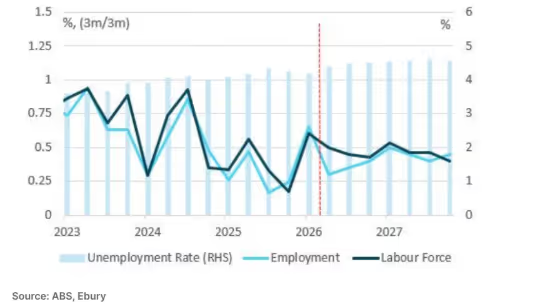
Australian labour force data for March was broadly in line with expectations, with the unemployment rate remaining at 4.3%. Employment growth closely tracked consensus, rising 18k through the month (market expectations: 19k). Indeed, jobs growth was entirely driven by FT employment, which rose by 52.5k through the month, whilst PT employment offset these gains, falling by 34.7k. Underemployment was unchanged at 5.9%, whilst the participation rate fell slightly to 66.8% (from 66.9% in Feb). Ultimately, this is a decent jobs print, especially given the mounting uncertainty surrounding the Middle East conflict. Looking past the monthly volatility, the underlying trend remains robust, with quarterly (3m/3m) employment growth steadily tracking higher at 0.7%. This growth has been driven by a balanced pick up in both FT (0.7%) and PT(0.6%) employment. Indeed, this rise in FT employment confirms the broader labour market's solid footing. However, downside risks are elevated, particularly with the impacts of the Middle East conflict starting to flow through the Australian economy. If these geopolitical tensions do persist for longer than expected, hiring intentions could fall, leading to a sharper-than-expected deterioration in the labour market. For now, in our view, despite these looming headwinds, the Australian labour market still remains resilient. Looking ahead, we continue to expect a modest cooling in the Australian labour market, forecasting the unemployment rate to reach 4.5% by end-2026 before peaking at 4.6% in mid 2027. Importantly, this upward drift will be driven by robust labour supply growth outpacing modest labour demand growth, rather than outright job losses. In the near term, the combination of higher interest rates and elevated geopolitical uncertainty stemming from the Middle East, in our view, is expected to temper hiring intentions. As employment growth naturally eases later this year, this supply-demand imbalance will continue to push the unemployment rate modestly higher over time.
Download the Full Report Here.