We are revising our cash rate forecast and now expect the RBA to hikethe cash rate 25bp in November, bringing the cash rate to 4.60%. We hadlong expected the RBA to hold the cash rate at 4.35% until the middle of2027. Data since the August meeting has surprised to the upside, but it's theRBA's own communication this week that has tipped the balance, with bothAssistant Governor Sarah Hunter and Deputy Governor Andrew Hausermaking it clear that further tightening is back on the table if inflation provesstronger than expected. As a result, we now expect the RBA to deliver onefinal hike in November.Whilst we have changed our view, it is worth flagging the specific datapoints and communication that have driven the shift.Growth through the June quarter was more resilient than the RBAexpected. GDP rose 0.4% over the quarter and 2.1% over the year, a touchabove where the RBA expected growth to be. And while growth should easethrough the second half of the year, with household spending, privateinvestment and public demand all holding up well, we see this as an upsiderisk to our view, and not a reason for the Board to hold off.Households remain resilient. Consumption has also been much strongerthan we expected, particularly in discretionary spending, which could pointto some consumption smoothing as household income growth remainsrobust. This strength in spending also comes as the housing market hastaken a turn, which should limit the RBA's concern about wealth effectsflowing through to spending and investment.Productivity remains weak and unit labour costs are rising. The latestnational accounts showed GDP per hour worked was flat through the Junequarter and down 0.2% YoY, while unit labour costs continued to climb, up3.6% YoY (from 3.2%). This combination of weak productivity and risinglabour costs is exactly the dynamic the RBA is worried about, particularlyagainst a backdrop of already elevated underlying inflation.Global inflation risks have also intensified. Brent crude is now flirting with$100 a barrel, its highest level since a brief spike above that mark in March,as renewed conflict around the Middle East disrupts tanker traffic throughthe Strait of Hormuz. Alongside this, the ongoing AI boom continues to addto capacity pressures rather than ease them, at least in the near term.Underlying inflation is proving sticky, not just strong. Trimmed mean inflation held at 3.6% annually in July, well above target, but is now annualising at 4.7% on a three month basis. Domestic inflation, which strips out tradable goods, is just as persistent, running at 4.4% annually and above4% since August 2025, evidence that price pressures are not fading. That will add to the Board's concerns following its August minutes flagging persistent capacity pressures. Services inflation adds to the unease,annualising at 4.6%, its highest pace since October 2025, while core services rose 0.9% over the month, following a 1% rise in June. Taken together, this points to growing stickiness in underlying price pressures, notjust a series running hot on one measure.
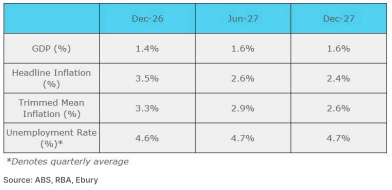
The labour market, whilst cooling, is still resilient. Unemployment hasdrifted up to 4.5%, but that remains broadly consistent with the RBA's own estimate of the NAIRU (full employment), giving the Board room to tolerate a little more slack and push rates higher if it needs to. The latest labour account data for the June quarter also showed jobs growth has been driven predominantly by the private and market sectors, a sign of underlying strength. Labour demand should still ease from here as higher rates and slower growth weigh, but for now, the labour market is still in decent shape.Most importantly, recent RBA communications have turned more hawkish.At the AFR Property Summit this week, Assistant Governor Sarah Hunter stated that inflation remains the Board's top priority and signalled the RBA may need to accept below trend growth, and higher unemployment, to bring it back within target, warning that "the board may well have to raise interest rates to tackle that" if price pressures prove stronger than expected. This was then followed by an ian interview with Deputy Governor Andrew Hauser, who said inflation remains the single biggest problem facing the economy. He stressed that there were growing upside risks to inflation as are sult of the ongoing Middle East conflict, the global AI boom, and Australia's persistently weak productivity. Taken together, this is the clearest sign yet that the RBA's patience is running thin and further tightening will be needed to bring inflation back to target in a timely manner.The RBA next meets on 29 September, with markets pricing around a 68%chance of a hike. We think November is more likely. The August CPI indicator is not released until 30 September, the day after the meeting, so a September move would be made on one month's data alone, something we think the Board will be reluctant to act on. We see the more sensible path as waiting for both the August and September data, which the Board will have in hand before November, giving it a stronger case to hike then.Indeed, with the change in our rate outlook, our modelling now shows softer growth outcomes ahead, with GDP growth expected to slow to 1.4% by end 2026 (was 1.5%) before modestly rising to 1.6% by end 2027 (was 1.8%). We also now expect the unemployment rate to peak at around 4.7% in early 2027 (was 4.6%). That said, we continue to expect inflation (both headline and core) to reach the mid-point of the RBA’s target range by Q3-2027.