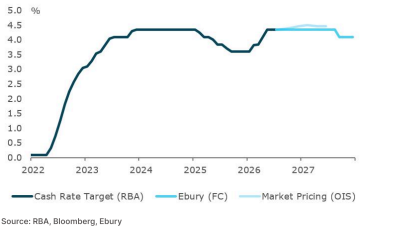
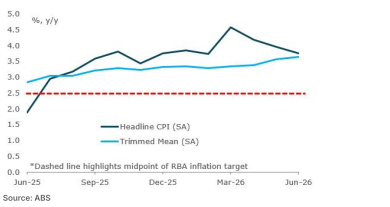
The RBA meets next week (11th August), where they will also provideupdates to their economic forecasts in their Statement on Monetary Policy(SMP). The RBA is widely expected to leave the cash rate unchanged at4.35%, a decision we agree with. The meeting will also come with updatedeconomic forecasts in its Statement on Monetary Policy (SMP). Since June,the data has painted a more encouraging picture than many had feared,with inflation softer than expected and clearer signs of cooling in the labourmarket and housing. That said, the slowdown has not been uniform, withhousehold spending holding up better than expected.On inflation, we think the path from here will be bumpy, but the worst is nowbehind us. Given the ongoing volatility at the headline level, we expect theRBA to keep its focus on underlying measures when setting policy. June CPIdata came in well below expectations, with the annual trimmed meanholding at 3.6%, undershooting both the RBA's own May SMP forecast of3.8%, while headline inflation eased to 3.8% well below the consensus of4%, largely on a soft fuel driven read.The one risk worth flagging is that housing inflation is ticking up quitestrongly, with new dwelling costs (which has the largest individual weight inthe CPI basket) rising to 5.8% YoY - its highest rate of growth sincemid-2023. Additionally, (non-tradable inflation continues to be a persistentissue, with the annual rate sitting at 4.9% YoY (or 5% on a 3m annualisedbasis). This, in our view, remains a key risk to an otherwise improvinginflation picture and will likely see RBA remain relatively hawkish and notwrite off any chance of further rate hikes ahead.Turning to the labour market, while there were some promising signs in Junewith employment jumping sharply, we still hold the view that the underlyingtrend shows signs of broader cooling. Despite this, as we have stressed fora number of months, looking through the monthly noise, quarterly (3m/3m)employment growth has softened recently and is running below labour forcegrowth, a dynamic we expect to keep pushing the unemployment ratehigher, toward a peak of 4.6% by late 2026. Additionally, with theunemployment rate currently at 4.4%, which already sits 0.2% above wherethe Bank expected it to be based on its May SMP, we expect next week'sforecast to show an increase in its unemployment rate outlook.
The housing market has clearly turned, with national house prices down 1.9%over the quarter to July as higher rates and tax policy changes cool demand.And while the RBA does not target house prices directly, it hasacknowledged that established market conditions have softened and creditgrowth looks set to slow, reflecting both policy pass through and thebudget's tax changes for housing investors. More importantly, the Bank hasflagged the risk of a material weakening in housing markets feeding throughto a slowdown in consumption via the wealth channel. Despite this, household spending is holding up much better than feared.Nominal spending rose 0.8% MoM June, well above expectations andfollowed May’s 1.2% gain. More importantly for the Bank, real spending(volumes) for the June quarter rose 0.7% QoQ, following 0.8% in Q1, a firmeroutcome than we had anticipated. Additionally, discretionary spendingstrengthened, rising 1.2% MoM and 6.7% YoY, the fastest annual pace sincemid-2023, supported by increased spending on electronic goods and liveentertainment. Overall, the data shows households holding up much betterthan feared, though this does not rule out a slowdown in demand stillemerging, with the impact of recent rate rises yet to be fully felt.Next week's SMP update should bring a downgrade to the Bank's inflationforecasts and an increase to its unemployment forecast. The RBA’s Mayforecast had trimmed mean inflation tracking at 3.8% and unemployment at4.2% by June 2026. Actual outcomes of 3.6% and 4.4% respectively suggestboth will need to be tweaked, inflation lower and unemployment higher. Inour view, this would correct what in hindsight was both a relatively elevatedinflation forecast and an overly optimistic view on the labour marketespecially given the Bank's own forecast of much weaker economic growth.On the rate outlook, we maintain our view that the cash rate stays on hold at4.35% for the remainder of 2026 and into 2027, with the next move a cut inthe second half of 2027. Markets are currently pricing around a 60%probability of a further hike by February 2027, though this has eased frombeing almost fully priced prior to last week's inflation data.