The RBA has little tolerancefor elevated inflation at themoment. If inflation keepscoming in strong, at least inthe near term, the Board willlikely have little choice but toraise rates again.
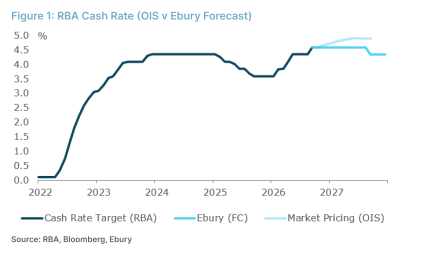
The RBA raised the cash rate by 25 bps to 4.60% on Tuesday, as widely expected, with the vote being unanimous. The statement clearly indicated that the Board has lost patience quickly this year with inflation persistently remaining above target, and a dovish hike would have risked blunting its effectiveness.The message was that the RBA is clearly focused on inflation. The first paragraph of the statement said some of the upside risks flagged in August were now materialising. The conflict in the Middle East has broadened and global energy prices are much higher than assumed in the August forecasts.
Additionally, AI related demand is lifting global technology goods prices, and liaison suggests firms facing cost pressures are lifting prices or looking to do so. Short term inflation expectations remain elevated and recent inflation outcomes were stronger than the Board expected at the previous meeting.On the other side of the ledger,the labour market was described as easing broadly as expected,and the Board appears willing to look through the volatility in the August labour force survey for now. The housing downturn was only flagged as an uncertainty.With unemployment still low, the Board looks comfortable moving quickly to return inflation toward 2.5%, and it made clear that further tightening remains possible.
Inflation ticks up in August
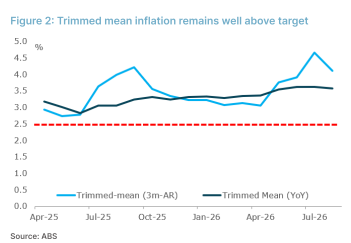
August CPI was a touch softer than expected, though it showed a pick up in inflation. Headline inflation rose 0.4% MoM in original terms (0.7% in SA terms), lifting annual inflation to 4.0% from 3.5%. That was just below the 4.1%consensus but a little above our 3.9% forecast.The more important number for the RBA, trimmed mean inflation, rose just 0.2% MoM (SA), leaving the annual rateat 3.6%, slightly below our 3.7% forecast. The 3m annualised pace eased to 4.1% from 4.7%, though this is still too high and well above the RBA's 2.5% midpoint.
Fuel was the main driver. Automotive fuel jumped 14.8% MoM after a 7.5% rise in July, adding around 0.5 ppts to the monthly headline and lifting annual fuel inflation to 13.5%.There were offsets. Holiday travel and accommodation fell 3.3% (domestic down 4.9%), subtracting around 0.2 ppts,while clothing fell 0.9% as garments dropped 1.9%. Food slipped 0.1% on weaker fruit and meat prices, although meals out and takeaway rose 0.2%. Housing rose just 0.2%, with rents up 0.3% and new dwelling purchase costs slowing to 0.16% from 0.37% in July, though these remain up 5.4% over the year.
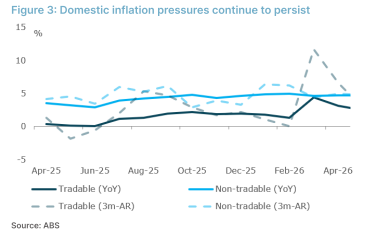
Other underlying measures of inflation were mixed.Domestic (non-tradable) inflation slowed to 0.3% MoM(SA) from 0.4%, while the 3m annualised pace slowed atouch to 3.9% from 4.1%, but the annual rate still edged upto 4.5% from 4.4%. Tradables inflation jumped around 1.5%MoM (SA) on fuel, lifting the annual rate to 2.9%. Goodsprices rose 1.1% MoM (SA) and were up 4.2% over theyear, compared with 3.2% in July. Services rose a moremodest 0.2% MoM (SA) and annual inflation eased slightly to 3.7%, yet the 3m annualised pace held at 4.6%, pointingto ongoing stickiness in inflation pressures.
Overall, the softer detail in new dwelling costs, clothingand food made the print slightly less worrying than July,but it does not change the broader picture. Trimmed meanis still annualising above 4% on a 3m basis, and fuel passthrough into other prices is a risk given firms continue topoint to ongoing cost pressures. In our view, a softmonthly print does not make a trend.Looking ahead, inflation will be bumpy because of baseeffects. Prices were flat across October and Novemberlast year, so annual inflation could ease a touch inSeptember before lifting again in October and November.That said, we now expect headline CPI to end 2026 at3.7% YoY with trimmed mean inflation ending the year at3.5%. Beyond this, we believe that the combination ofhigher rates and a slowing Australian economy growth willbring inflation back to target in the second half of 2027.
An important month ahead for the RBA
The August CPI likely validated the RBA's view that inflation is a problem and justified Tuesday's hike. Lookingahead, we think the RBA faces a tricky path. Our basecase is that the cash rate stays at 4.60% for the rest ofthis cycle, but the risks are skewed to the upside. Ifanother hike is needed, we expect it this year, mostprobably in November after the Q3 CPI (due 28thOctober). September labour force data will also landbefore the November meeting, but with the Board thisfocused on inflation, the CPI will clearly carry the mostweight.