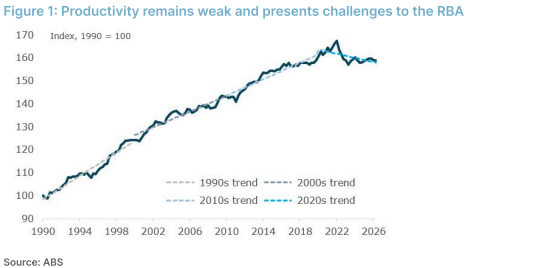
The Aussie strengthened last week, climbing above 72 US cents towards the end of the week. The late-week move was driven by broader US dollar softness ahead of the NFP release, alongside firming RBA rate expectations. That said, the currency briefly sold off following a stronger than-expected August payrolls print, before recovering later in the session on comments from President Trump.In terms of data, the key focus domestically was the Q2 GDP release.Australian GDP rose 0.4% QoQ / 2.1% YoY, coming in above market consensus of 0.3% QoQ / 1.8% YoY, and matching our QoQ forecast of0.4% (though YoY surprised to the upside versus our 1.9% view as the re were upward revisions in prior quarters). The result marks a step-up from the 0.3% quarterly growth recorded in Q1 2026, though the annual rate of growth continued to ease. In terms of the composition of growth In terms of the composition, household consumption rose 0.4% QoQ (+0.21 ppt to quarterly growth), with discretionary spending up 1.4%.Dwelling investment was solid, up 1.6% (+0.08ppt), yet this was almost fully offset by weaker private business investment, which fell 0.5%(-0.06 ppt), due to a 5.6% fall in machinery investment. Public demand rose 1.4% (+0.06 ppt), driven by stronger public spending (+0.6%). Net exports added 0.10 ppt to growth as exports climbed 0.9% - supported by strong services and coal exports - even as imports rose 0.5%. One key concern from the release was again on productivity growth ,which continues remains a key concern for the RBA. GDP per hour worked was flat through the June quarter, with annual growth down -0.2%.Meanwhile, unit labour costs rose quite sharply, up 1.2% QoQ and were up 3.6% YoY (from 3.2%). This combination of weak productivity and rising unit labour costs is exactly the dynamic the RBA will be concerned about especially given growing underlying inflation pressures. Overall, the data doesn't shift our long-held view that the RBA stays on hold until mid-2027. That said, the balance of risks has moved in recent weeks, and continued upside surprises in upcoming data could prompt usto revisit this view.
US non-farm payrolls rose a net 162k in August, well above the 55k consensus, with June and July revised up a combined 55k, while the unemployment rate held steady at 4.1%. Markets now price a 60% chanceof a September Fed hike, a view we remain skeptical of, though the data bolsters the hawks' case. The release was quickly followed by comments from President Trump, who praised the report while threatening to halt trade with deficit countries unless the Fed cuts rates.Additionally, US ISM surveys for August were also released last week, and suggested some mixed signals around US activity. Manufacturing PM Ieased to 54.6 (from July's near four-year high of 55.6), although it continued to run for an eighth straight month of expansion. That said,new orders and employment both slowed, and price pressures still remain elevated. Services PMI surprised higher, rising to 55.4 (from 54.1) on stronger business activity and new orders, though employment contracted for a second month, while prices paid hit a four-year high of72.6. Firms across both sectors continued to flag tariffs and Middle East related disruption as key pressures on costs and supply chains.As flagged in our G3 update last week, one of the key developments in financial markets was the broad-based sell-off in government debt globally, pushing yields to multi-year highs. This reflected invest or concerns over widening fiscal deficits, surging AI-related borrowing, and the ongoing conflict in Iran, the latter also driving oil prices higher. The dollar has found some support from the rise in US yields coinciding with hawkish commentary from Fed Chair Warsh, with rate differentials doing the work even as broader volatility stays subdued. With bond market pressures showing few signs of abating, the coming month looks set tobe a critical test for policymakers, with the ECB, BoJ, and the Fed all facing decisions on whether to hike into a backdrop of surging yields. The key swing factor for the US dollar will be whether this hawkish repricing proves durable, or fades if upcoming jobs and inflation prints undershoot expectations.Tensions in the Middle East escalated further this week, with the US carrying out a second wave of strikes on Iranian targets within three days,following Sunday's strikes on Iranian rocket launchers at Larak Island inthe Strait of Hormuz. Iran responded with further drone and missile strikes on US bases in the region, while shipping risk through the Strait remains elevated after tankers exiting the Strait were hit by projectiles earlier in the week. Over the weekend, the US military struck three Iran linked oil tankers in retaliation for Tehran targeting two American warships, permanently disabling two vessels and destroying a third in the Gulf of Oman. Iran's state media confirmed the strikes, adding that Tehran had responded by hitting three US-affiliated vessels and three oil tankers travelling an unauthorised route through the Strait. Despite the disruption,US officials say flows have held up, with crude exports averaging around 8mb/d, though pressure is building in refined fuel markets, with US gasoline inventories at a decade low and East Coast distillate supplies at a record low. Brent crude has continued to climb on the escalation,ending the week above $96/bbl.