The Aussie dollar has edged modestly higher this week, with few key catalysts in the FX market.
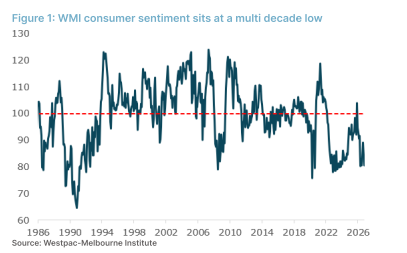
On the domestic data front, the focus was on WMI consumer confidence data. Consumer sentiment weakened again in October, with the WMI confidence index falling 4.7% to80.4 from 84.4 in September. At this level, confidence near it slowest level puts the reading among the lowest on record, andit extends a run of very low printsthat began in 2022.
Interestingly the survey timingshowed some insightful responses, with respondents interviewed before the RBA's rate hike providing a confidence reading of 86.9, slightly above September. However, those nterviewed afterwards came inat 67.2, a level last seen during the early 1990s recession.
Indeed, the latest cash rate decision coinciding with higher petrol prices hit household finances hardest. The gauge of finances versus a year ago fell 8% to 66.9, matching April's extreme low, while the forward looking measure dropped 6.4%.
Views on the broader economy also softened. The time to buy a major household item index,which tracks discretionary spending closely, fell 7.1% and sits well below its long run average. That points to weaker spending later this year, though there have been little signs of softening in the data so far this year.
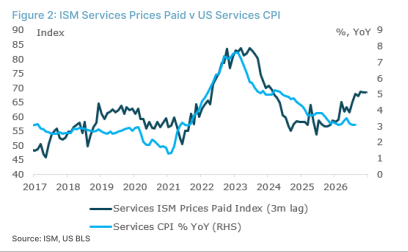
Rate expectations climbed 5.5% to 179.7, just shy of May's cycle peak. Among those surveyed after the hike, just over 80% expect mortgage rates to rise further over the nextyear, up from 63% last month, and the share is closer to90% among mortgage holders. On the labour market, the unemployment expectations index rose further through the month, pointing to a higher unemployment rate ahead. Surprisingly, the sentiment around the housing market wasthe notable exception. The time to buy a dwelling index rose 3.4% to 88.4, likely as a result of the recent easing in house prices. Whilst house price expectations gained 4.3%to 115.1 after a sharp slide over the previous six months.Globally, it has been a relatively quiet week on the data front, with just a few key releases out of the US. The September ISM services index slipped to 54.9, yet still remained expansion for a 27th straight month. Activity cooled, with the business activity gauge falling to 56.5 andnew orders easing to 59.8. Firms are still facing rising input costs, with prices paid climbing 1.4 pts to 74.0. This points to elevated services inflation ahead. Employment moved back above 50 at 50.1, pointing to a labour market that looks broadly balanced.The US trade deficit blew out to USD 105.6 bn in August from USD 92.8 bn in July, its largest since March 2025 when importers rushed in goods ahead of tariffs. Imports jumped 4.3% m/m, led by crude oil, gold and capital goods, outpacing a 1.4% rise in exports. Deficits with Mexico and Vietnam hit record levels, and the gap with Canada also widened sharply.
Beyond the data, the focus was the FOMC minutes released this morning, which struck a mildly hawkish tone.Most participants saw another hike by year end as likely appropriate, and several felt policy was only mildly restrictive at best, with economic momentum appearing to build. Many also judged financial conditions as supportive of growth, pointing to strong equities and tight corporate spreads despite higher Treasury yields.That said, global markets have been interesting, in particular the bond market. The selloff continued into this week, with the US 10 year yield jumping as high as 5.35%,its highest since April 2002, while the 30-year touched 5.70%, its highest since May 2002. Both have since pulled back, but yields continue to remain elevated. In our view,Fed pricing is not the driver, with markets still seeing only a one in five chance of a hike later this month. This points to a higher term premium on heavy borrowing, inflation risks and AI driven growth expectations. In Europe, French bonds were back in focus as the budget process kept markets on edge. Indeed, the French and German 10 year yield spread reached nearly 1.5%, its widest since the 2012 euro crisis, and the euro has also come under pressure.On oil markets, Brent crude edged higher over the past day as Middle East tensions picked up again. Iranian state media reported a blast heard from the sea off Qeshm Island, reviving concerns of another flare up in the conflict with the US. In saying this, prices have been choppy this week, with traders weighing rising supply out of the Persian Gulf against the risk to tankers moving through the Strait of Hormuz.