September CPI came in stronger than expected, with headline inflation rising 0.8% MoM in original terms (0.6% in SA terms)and lifting the annual rate to 4.3%from 4.0% in August. That compares with consensus of 0.7% MoM and 4.2% annually,and our forecast of 0.35% MoM and 3.9%.The more important number for the RBA, trimmed mean inflation,rose 0.3% MoM (SA), matching both our forecast and consensus of 0.3%, with the annual rate rising to 3.6%, up from a revised 3.5% in August. For the quarter,trimmed mean rose 1.0% QoQ, inline with both consensus and our forecast and up from 0.8% in Q2,a pace that annualises (on a quarterly basis) at around 4% andsits well above the RBA’s 2.5%midpoint of their inflation target.
Holiday travel and fuel were the main drivers behind the headline outcome, together adding around 0.75ppts to the monthly print. Holiday travel and accommodation rebounded 7.6% MoM after falling 3.3% in August, while automotive fuel rose 9.4% on higher world oil prices, although that was slower than the 14.8% jump in August.Clothing, household equipment and electricity provided offsets that subtracted around 0.15 ppts from monthly growth. Housing rose 0.3% MoM with rents up 0.2% and new dwelling purchase costs little changed,taking annual new dwelling inflation down to 4.7% from 5.4%, while property rates and charges rose 5.5% and added around 0.1ppts. Food inflation was little changed as lower meat and dairy prices offset higher fruit prices.
Other underlying measures were solid, with domesticinflation rising 0.3% MoM (SA) and the annual rate holdingat 4.5%, while the 3m annualised pace slowed to 4.2%from 4.4%. Tradables inflation rose 1.2% MoM (SA) on fuel,lifting the annual rate to 4.0% from 2.9%. Goods pricesrose 0.7% MoM (SA) and are up 4.6% over the year,compared with 4.2% in August, while services rose 0.6%MoM (SA) with the annual rate rising to 4.1% from 3.7%and the 3m annualised pace at 5.9% versus 4.7%previously.
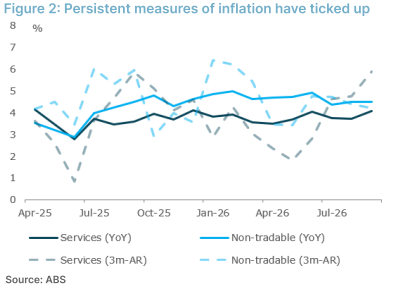
Overall, the detail across trimmed mean, domestic (nontradable) and services inflation suggests to us thatinflation pressures are persistent and showing little signsof fading. Indeed, with trimmed mean annualising ataround 4% on a quarterly basis and fuel pass through stillfeeding into other prices, we believe the Board will readthis outcome as confirmation that inflation is movingfurther from target rather than closer to it.Looking ahead, inflation will remain bumpy because ofbase effects. Prices were flat across October andNovember last year, so annual inflation is likely to liftfurther in those months before easing in December, whenlast year’s large increase drops out of the base. On ourcurrent assumptions we expect headline CPI to end 2026at 4.2% with trimmed mean inflation ending the year at3.5. Beyond this, we believe that the combination ofhigher rates and a slowing Australian economy will bringinflation back to target in the second half of 2027.
Melbourne Cup Day hike set in stone. We have long held the view that the RBA would place significant weight on this CPI print, and we now expect the Board to raise the cash rate by 25bps to 4.85% when it meets next week given the strength in the data.This change in call is also supported by recent hawkish commentary by RBA Board members. Deputy Governor Hauser said the inflation outlook looked materially worse than the August projections and that the September quarter trimmed mean was likely to come in above whats taff had assumed, while Assistant Governor Hunter said the Board had not yet done enough despite four hikes this year, with more of the oil price shock still to flow through.Both acknowledged that the labour market was easing and consumption was tepid, yet both made clear that bringing inflation down and keeping expectation sanchored was the priority, with Hunter adding that the Board was not looking to push the economy into recession.
The minutes of the September meeting point the same way, concerned that excess demand is greater than it had assessed and prepared to accept slower growth in demand and employment to return inflation to target. As we outlined in our review of September’s LFS data, we think the weight has shifted in recent months from the labour market towards inflation, and the recent fall in employment and modest rise in the unemployment rate fit with a Board that is happy to let the labour market cool gradually. Indeed, today’s inflation data also cements the Board’s view that inflation pressures are building, and with quarterly trimmed mean inflation at 1.0% there is little room to wait for further evidence before acting.Markets were pricing a 64% chance of a hike ahead of the release, which has since surged to 84% (at the time of writing), making the decision a much clearer call.Attention will also focus on the bank’s updated forecasts in its SMP, as well as any guidance on whether further tightening is needed. Beyond next week, we currently seeno scope for further tightening, although additional hikes could be warranted if the inflation backdrop continues to worsen, something we do not expect until next year.