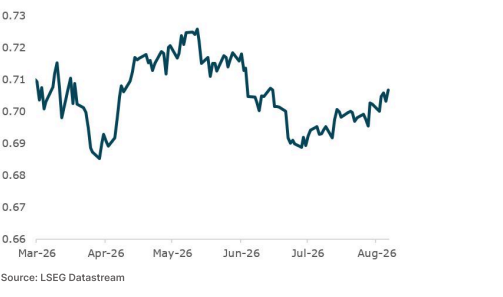
The Aussie ended the week firmer, with the bulk of its gains coming latein the week as a much weaker than expected US payrolls print sent the dollar broadly lower. AUD had spent most of the week in a tight range,drawing support midweek from stronger than expected household spending data, but it was Friday's NFP miss that did the heavy lifting. Domestically, the key release was ABS household spending data for June,as flagged in Wednesday's mid-week update. Nominal spending rose0.8% MoM, well above the 0.2% consensus and following May's 1.2% gain,while spending volumes for the June quarter rose 0.7% QoQ after 0.8% inQ1. Additionally, discretionary spending was also strong, rising the standout, up 6.7% YoY, its fastest annual pace since mid 2023. The upside surprise does not rule out a slowdown in consumer demand still emerging,with the impact of past rate rises yet to be fully felt.Attention now turns to the RBA meeting tomorrow, where the Bank iswidely expected to leave the cash rate unchanged at 4.35%, a call we agree with (as we flagged in our preview last week). Data since June has been encouraging on balance, with softer than expected inflation andclearer cooling in the labour market and housing, even as spending has held up better than feared. Trimmed mean inflation for June held at 3.6%,undershooting the RBA's own May forecast of 3.8%. That said, elevated housing and non-tradable (domestic) inflation argue against the Bank fully closing the door on further hikes. On the labour market, we still hold the view that it is cooling. Employment growth on a quarterly (3m/3m) basis,running below labour force growth and unemployment, at 4.4%, is above where the RBA expected it in May. Indeed, the RBA will also provide an update to its economic forecasts inits Statement on Monetary Policy (SMP). We expect the SMP to show downgrades the inflation forecast alongside increasing its unemployment forecast. In terms of the rate outlook, we maintain our view that the cash rate stays on hold at 4.35% for the remainder of 2026 and into 2027, with the next move a cut in the second half of 2027.
The yen was the main talking point globally this week, after US and Japanese authorities confirmed joint intervention to support the currency, the first such campaign since 1998. As flagged in our midweek update, Japan reportedly did the bulk of the work, with intervention totalling close to $80bn and dwarfing the scale of its earlier attempts this year, while the Fed appeared to support via euro sales rather than direct dollar selling. The scale of US involvement remainsunclear, though the signalling effect likely matters more than the actual flows. The move reflects growing concern in Washington that yen weakness has been pushing Japanese bond yields higher, with worries this could eventually spill over into Treasuries given Japan's status as one of the largest foreign holders of US debt.USD/JPY settled towards 157.8, up from the lows of 155.5 earlier in the week, yet well below the 163 levels at the end of July prior to the intervention. Overall, we still hold the view that intervention tends to buy time rather than reverse a trend outright. Indeed, further strengthening in the yen will likely hinge on US data softening enough to keep the Fed sidelined, alongside a BOJ hike in September that markets are now fully pricing.On the Middle East, Brent crude oil pared its weekly losses as optimism around a reopening of the Strait of Hormuz ran into fresh complications.Brent fell to a low near $78/bbl midweek after Iran said it had reached agreement with Oman on a proposed shipping route through the waterway, only to recover to around $84/bbl by week's end as the terms of that proposal drew scrutiny. Iranian media indicated Tehran would seek to bar US and Israeli vessels from the strait and demand compensation from other states deemed hostile before granting passage, a stance that would leave most Gulf producers restricted in practice.The proposal was also reported to require the US to lift its blockade of Iranian ports, a condition Washington has so far resisted given its insistence that no single country control transit rights.Renewed disruption added to the caution, with Iran's Fars news agency reporting strikes on hostile targets within the strait and Houthi forces claiming a large scale attack on Saudi backed troops in Yemen, layered on top of ongoing threats to Red Sea shipping. Markets nonetheless took some comfort from signs that oil flows are gradually recovering.The week closed out with July's US payrolls report, which showed a net loss of 23k jobs against a consensus for a gain of 85k, while the prior two months were revised down by a combined 103k. Wage growth also slowed sharply, with average hourly earnings up just 0.1% on the month against 0.3% expected, and 3.2% year on year from 3.5% previously,easing concerns around wage price inflation. The unemployment rate unexpectedly fell to 4.1% from 4.2%, though this was largely a function of workers exiting the labour force as participation continued to decline.For the Fed, the data reinforces the case to stay on hold at the September meeting and supports our view for a prolonged pause,though futures are still pricing around a 30% chance of a hike, with investors likely wanting to see confirmation of cooling inflation in next week's CPI print before committing firmly to a status quo view.